





Top End Li'l Excelerator
This Kid-sized handcycle is safe for even the first-time cyclists


Top End Li'l Excelerator

 /mo*
/mo* 
The SpinKids Difference Includes:
FREE Curbside Delivery
 FREE Curbside Delivery
 2 Year Limited Warranty
Made in the USA
 Price Match Guarantee
  FREE Shipping
 WARRANTY
Features
- Sized for smaller riders.
- Seat adjusts forwards and backwards for easier transfers
- Easy-to-reach 7-speed shifter.
- Adjustable dual footrests and safety straps.
- Carbon steel frame and fork
- Adjustable crank height.
- Adjustable tension upholstery.
Key Specs
- Weight capacity: 250 lbs.
- Weight: 40 lbs.
Manuals, Literature & Videos
Overview
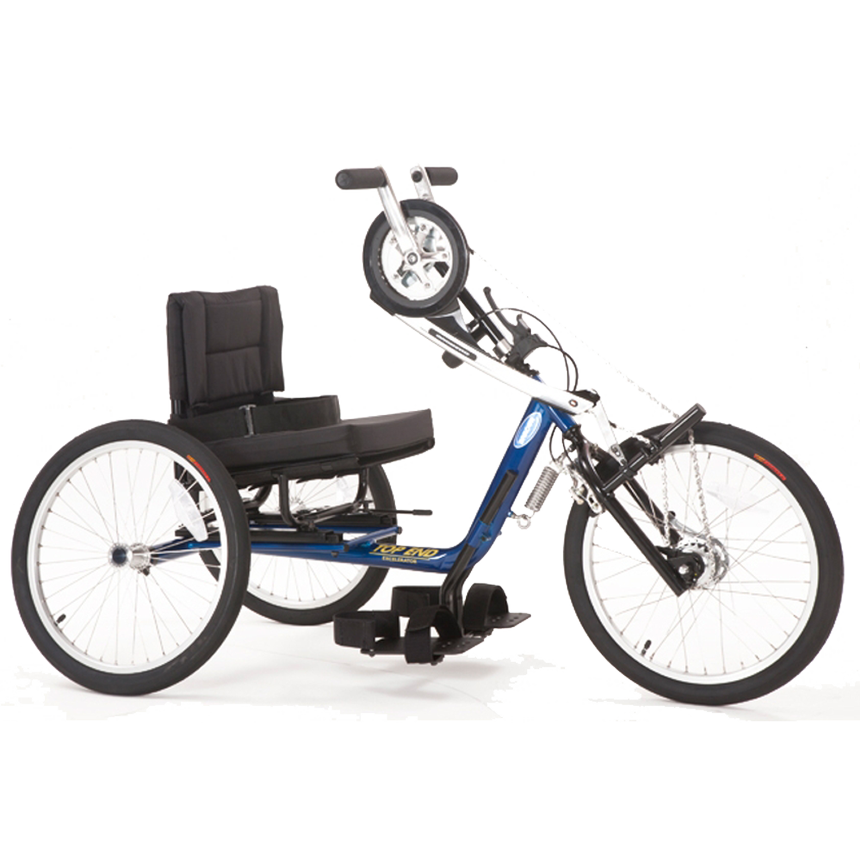
Sized for smaller riders, the Invacare Top End Li'l Excelerator handcycle is a great way for kids to exercise. The 7-speed hub with reversing brake means hands never have to leave the handles, making for a safer ride.
Stable and maneuverable, this kid-sized handcycle is safe for even the first-time handcyclist. The 7-speed hub with reverse braking means your child’s hands never have to leave the handpedals. The Li’l Excelerator Handcycle is an upright style handcycle that makes transferring in and out of it very easy. Totally adjustable, the Li’l Excelerator Handcycle will fit children 42? to 62.” It features a simple fore-aft (forwards/backwards) sliding seat, uncomplicated adjustable footrest system and a straightforward crank height adjustment. The Li’l Excelerator is pictured with our optional horizontal handpedals which is preferred by younger children. Standard safety features include: reflectors, full chain guard, footrest safety straps, safety flag, cushion and seat restraint. The Invacare Top End Li’l Excelerator Handcycle is totally adjustable and ready to go.
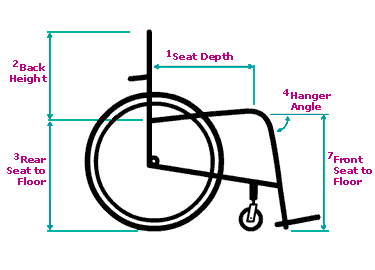
- Seat Depth1
- Measure from the most posterior point of the body to the inside of the knee, minus at least two inches. Optimal contact between the legs and the seat increases stability for the body.
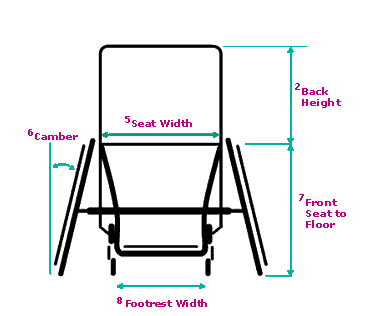
- Back Height2
- Measured from the seat base to the top of the chair back. Sport users need enough height for upper body support, yet low enough to allow the arms and trunk to rotate freely.
- Rear Seat to Floor3
- Measurement from the ground to the rear seat edge. Relative to the front seat-to-floor dimension, this determines the rearward slope ("dump" or "squeeze") of the seat. Sport chairs usually have more dump for extra upper body stability.
- Hanger Angle4
- Determines how far the toes extend away from the body, measured from the horizontal. Sport users often use very tight angles to be able to rotate in the smallest possible space.
- Seat Width5
- Determined by the widest point of the body from knee to hip, plus an inch to ensure room to move. Sport chairs are typically as narrow as possible to save weight which improves agility.
- Wheel Camber6
- Angle of the wheel relative to the vertical. More camber improves stability and agility, but also limits ability to pass through narrow spaces. A typical sport chair uses nine to twelve degrees of camber.
- Front Seat to Floor7
- Measure the leg from the back of the knee to the sole of the foot. Then subtract the thickness of the cushion when it is compressed. Next, add a minimum of two inches for footrest clearance. Do not add the footrest clearance if the chair will be foot-propelled.
- Footrest Width8
- Measure from the inside of each legrest tubing the distance or desired distance between legrests.
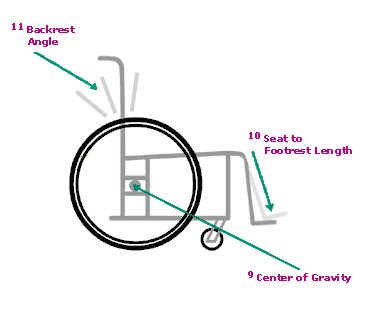
- Center of Gravity9
- Measure from the front of the seat back post to the center of the rear axel.
- Seat to Footrest Length10
- Measure from the edge of the seat upholstery to the top rear of the footrest.
- Backrest Angle11
- Measure the the angle of the back post to the floor. Ninety degrees will be perpendicular to the floor, to approximate the angle from the back post to the seat, subtract two degrees from measurment for every .5" of dump.
More Information on the Top End Li'l Excelerator
See also: