


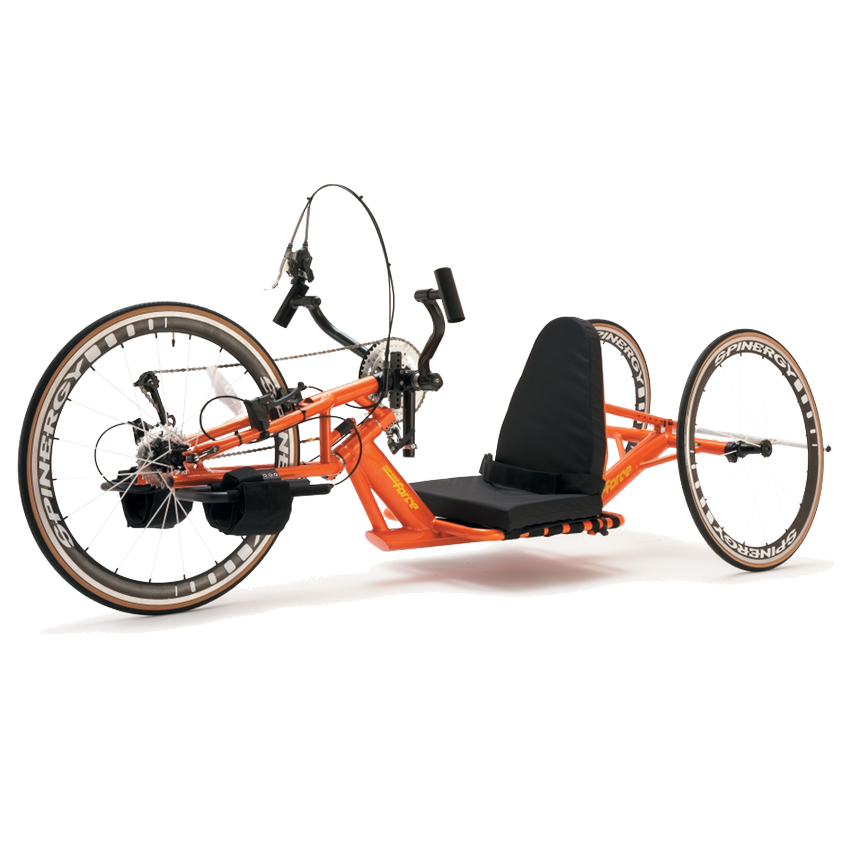
Top End Force G Handcycle
Competitive Handcycle which maximizes your abdominal, arm, shoulder and chest muscle power.


Top End Force G Handcycle

 /mo*
/mo* 
The SpinLife Difference Includes:
3 Year Limited Warranty
 3 Year Limited Warranty
 Made in the USA
 Price Match Guarantee
  FREE Shipping
 WARRANTY
Features
- Adjustable back angle (55-90 degrees), back height, leg rests
- Crank height
- Adjustable fore/aft seat position
- Easy-to-operate shifting and braking
- Virtually maintenance-free
- 26-inch high performance wheels
Key Specs
- Quick-Release Axles: No
- Weight capacity: 250 lbs.
- Starting Weight: 32 lbs.
Manuals, Literature & Videos
Overview
The Top End Force G provides excellent performance due to its aerodynamic design. It features an adjustable, trunk-powered, erect position for low paras, amputees, and competitors who can “gut” it out using abdominal, arm, shoulder and chest muscles. The center frame construction has an internal rib which reinforces the frame making it super stiff for maximum transfer of power. The Force G’s center frame design also allows for transfers that are easier than any other handycles in its class. Control through the turns is smooth yet fast with the Top End steering dampener system. The 27 speeds operated by the Rapid fire hands-on shifter/ brake delivers smooth, responsive shifting and braking right at your fingertips plus the easy-to-operate, no cable, virtually maintenance-free manual upper derailleur system take the guess work out of the chain rings.
The Top End® Force™ G Handcycle features the adjustable back angle (55°-90°), back height, leg rests, crank height and fore/aft seat position allows you to dial in your ultimate power position.
The Force G Handcycle can be considered a cross trainer and is used by athletes classified as an H4 or H5.
It’s a great core workout and allows you to see the traffic a bit easier than the recline-only positioned handcycles.
FEATURES
• Custom skeletal reinforced aluminum frame
• Adjustable back angle
• Aluminum oversized rake fork
• Travel ready front fork
• Adjustable crank housing
• Multi-position adjustable footrests
• Safety straps
• Invacare® Top End® V or S crankset
• Ovalized aluminum ergonomic handpedals
• 30-speed drivetrain
• Hands-on shifters brake
• 11-34 SRAM® cassette
• Cable driven upper derailleur shifter
• Upper chainrings: 48-39-24
• Steering dampener
• 26" high performance wheels
• High pressure clincher tires
• Threaded axles
• Drafting bumper
• Flip level parking brake
• Seat and back cushions
• Chain guard
• Safety flag
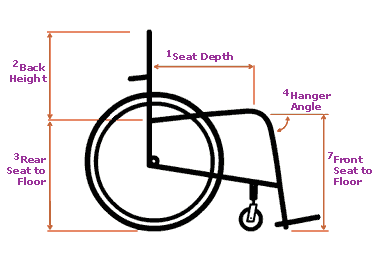
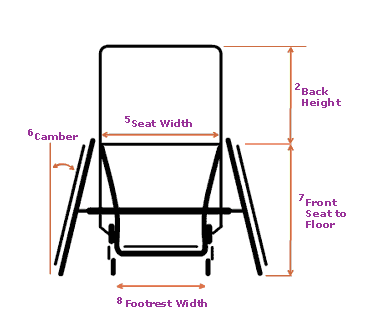
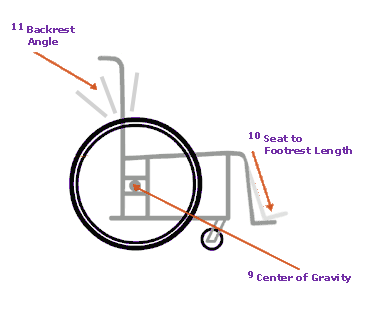
- Seat Depth1
- Measure from the most posterior point of the body to the inside of the knee, minus at least two inches. Optimal contact between the legs and the seat increases stability for the body.
- Back Height2
- Measured from the seat base to the top of the chair back. Sport users need enough height for upper body support, yet low enough to allow the arms and trunk to rotate freely.
- Rear Seat to Floor3
- Measurement from the ground to the rear seat edge. Relative to the front seat-to-floor dimension, this determines the rearward slope ("dump" or "squeeze") of the seat. Sport chairs usually have more dump for extra upper body stability.
- Hanger Angle4
- Determines how far the toes extend away from the body, measured from the horizontal. Sport users often use very tight angles to be able to rotate in the smallest possible space.
- Seat Width5
- Determined by the widest point of the body from knee to hip, plus an inch to ensure room to move. Sport chairs are typically as narrow as possible to save weight which improves agility.
- Wheel Camber6
- Angle of the wheel relative to the vertical. More camber improves stability and agility, but also limits ability to pass through narrow spaces. A typical sport chair uses nine to twelve degrees of camber.
- Front Seat to Floor7
- Measure the leg from the back of the knee to the sole of the foot. Then subtract the thickness of the cushion when it is compressed. Next, add a minimum of two inches for footrest clearance. Do not add the footrest clearance if the chair will be foot-propelled.
- Footrest Width8
- Measure from the inside of each legrest tubing the distance or desired distance between legrests.
- Center of Gravity9
- Measure from the front of the seat back post to the center of the rear axel.
- Seat to Footrest Length10
- Measure from the edge of the seat upholstery to the top rear of the footrest.
- Backrest Angle11
- Measure the the angle of the back post to the floor. Ninety degrees will be perpendicular to the floor, to approximate the angle from the back post to the seat, subtract two degrees from measurment for every .5" of dump.