


Top End Eliminator OSR Racer
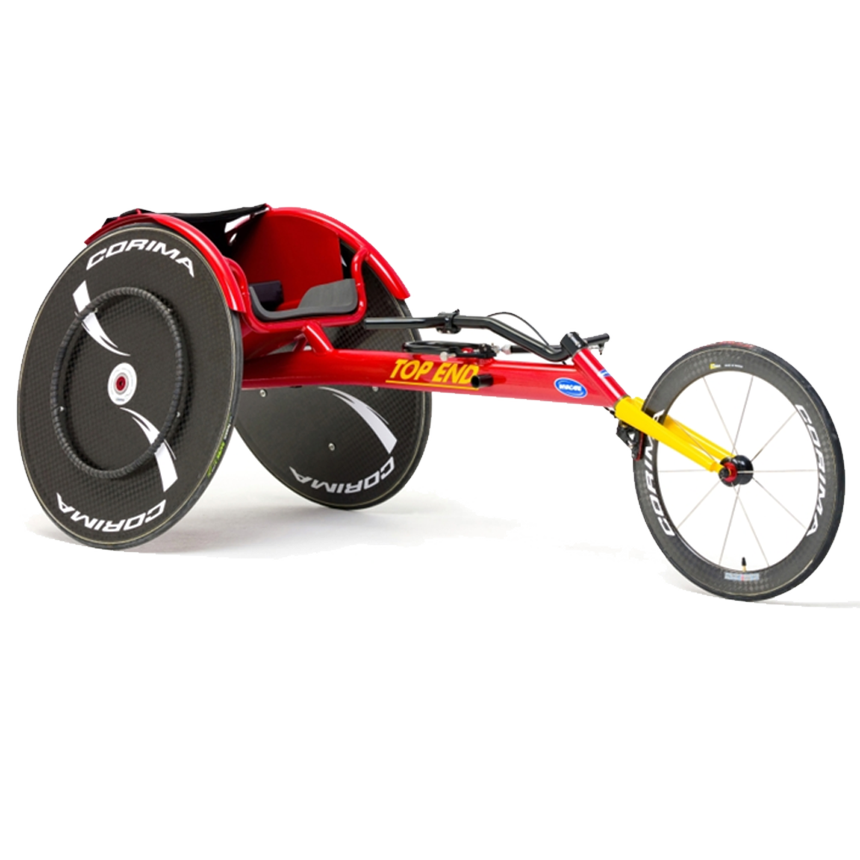
Racing wheelchair with exceptional stability and 3 seat styles


Top End Eliminator OSR Racer

 /mo*
/mo* 
The SpinLife Difference Includes:
2 Year Limited Warranty
 2 Year Limited Warranty
 Made in the USA
 Price Match Guarantee
  FREE Shipping
 WARRANTY
Features
- Three cage styles to choose from : U, I and V style
- Top mounted precision track compensator.
- Adjustable/Removable handlebar bar-ends.
- Super-Stiff Roll Formed Horizontal Maintube.
- Relaxed headtube angle for exceptional stability and front wheel cornering traction.
Key Specs
- Weight capacity: 250 lbs.
- Starting Weight: 14 lbs.
Manuals, Literature & Videos
Overview
The Top End Eliminator OSR Racer has the same great custom 6061 T6 frame with integral wrap-around fenders, aluminum side panels, 700C high-performance rear wheels and 20" front wheels.
Designed for speed, the Top End® Eliminator™ OSR racing wheelchair offers exceptional stability and aerodynamics. The Eliminator™ OSR racing wheelchair features a relaxed head tube angle for great cornering and maximum traction. Combined with the stiff aerodynamic T-frame design, precision track compensator system, integral wrap around fenders, aluminum side panels and rubber coated push-rims plus a choice of three cage styles to maximize personal performance, it is easy to see why it the choice of champions around the world.
THREE CAGE / SEAT STYLES TO CHOOSE FROM:
OPEN I CAGE STYLE
- The Open I cage is Recommended for beginner level and/or lower functioning athletes and is designed for people who prefer the seated position only. The I cage is more open in the front allowing for easier transfers. the I Cage design is for the perfect chair for athletes who are beginning to race or for athletes that have difficulty with transfers.
- The I Cage is the easiest style to get in and out of.
- It can be used only in the traditional feet-forward position.
- Athletes will need fair to good balance/transfer skills.
OPEN V CAGE STYLE
- The Open V cage is Recommended for beginner level athletes with T-10 SCI and above as that level of injury requires more of a bucket. Designed for people who prefer the seated position and/or may also want to kneel. The Open V Cage design is for the perfect chair for athletes who are beginning to race – it can be used kneeling or feet forward. This cage does require good transfer skills.
- Athletes who like the option to choose either traditional feet forward or the kneeling position.
- The super-stiff horizontal maintube, combined with a relaxed headtube angle for stability and aerodynamics, makes it designed for speed.
OPEN U CAGE STYLE
- The U cage is Recommended for more advanced athletes whom wish to kneel only. The U cage frame design does not allow for the sitting position. Designed for speed specifically for athletes who use the kneeling position or need an amputee seat. This cage does require good transfer skills.
- U Cage includes an aluminum knee plate for extra rigidity. Follow measurement guidelines located in our FAQ section for a good fit and a great start.
- What makes it so fast? The super-stiff formed horizontal main tube, combined with a relaxed headtube angle for stability and aerodynamics.
FEATURES
- Features 6061 T6 oval tube custom aluminum frame
- Integral wrap-around fenders
- Kneeling, amputee or traditional upholstery
- 700C or 26" high performance rear wheels
- Caliper hand brake
- Aluminum side panels
- Straight axle tube with rear wheel alignment
- Aluminum fork
- Precision track compensator system
- 20" front wheel with tubular tire
- Rubber-coated 3/8" diameter aluminum rims
- Powder coat paint
- 250 lb. weight capacity
OPTIONS
- Carbon fiber rear wheels
- Corima™ carbon fiber front wheel
- Alignment gauge
- Wheel bag
- Solid seat
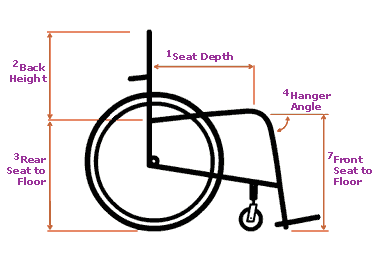
- Seat Depth1
- Measure from the most posterior point of the body to the inside of the knee, minus at least two inches. Optimal contact between the legs and the seat increases stability for the body.
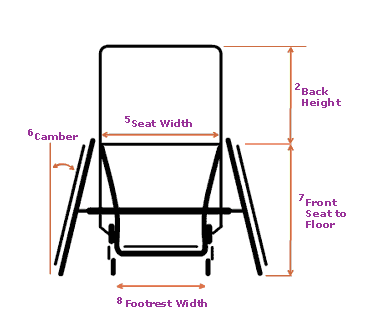
- Back Height2
- Measured from the seat base to the top of the chair back. Sport users need enough height for upper body support, yet low enough to allow the arms and trunk to rotate freely.
- Rear Seat to Floor3
- Measurement from the ground to the rear seat edge. Relative to the front seat-to-floor dimension, this determines the rearward slope ("dump" or "squeeze") of the seat. Sport chairs usually have more dump for extra upper body stability.
- Hanger Angle4
- Determines how far the toes extend away from the body, measured from the horizontal. Sport users often use very tight angles to be able to rotate in the smallest possible space.
- Seat Width5
- Determined by the widest point of the body from knee to hip, plus an inch to ensure room to move. Sport chairs are typically as narrow as possible to save weight which improves agility.
- Wheel Camber6
- Angle of the wheel relative to the vertical. More camber improves stability and agility, but also limits ability to pass through narrow spaces. A typical sport chair uses nine to twelve degrees of camber.
- Front Seat to Floor7
- Measure the leg from the back of the knee to the sole of the foot. Then subtract the thickness of the cushion when it is compressed. Next, add a minimum of two inches for footrest clearance. Do not add the footrest clearance if the chair will be foot-propelled.
- Footrest Width8
- Measure from the inside of each legrest tubing the distance or desired distance between legrests.
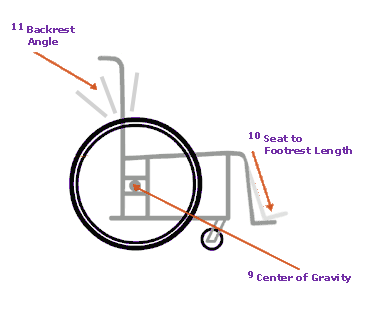
- Center of Gravity9
- Measure from the front of the seat back post to the center of the rear axel.
- Seat to Footrest Length10
- Measure from the edge of the seat upholstery to the top rear of the footrest.
- Backrest Angle11
- Measure the the angle of the back post to the floor. Ninety degrees will be perpendicular to the floor, to approximate the angle from the back post to the seat, subtract two degrees from measurment for every .5" of dump.