


Eliminator NRG Racing Wheelchair
A light and responsive competitive racing chair.


Eliminator NRG Racing Wheelchair

 /mo*
/mo* 
The SpinLife Difference Includes:
2 Year Limited Warranty
 2 Year Limited Warranty
 Made in the USA
 Price Match Guarantee
  FREE Shipping
 WARRANTY
Features
- 200-gram full carbon fork features
- 4 Steering Handle options
- Vertical or Horizontal Steering control
- 70" or 74" overall length
- 1/2" customizable frame measurments
- Can come assembled!
Key Specs
- Weight capacity: 250 lbs.
- Starting Weight: 19 lbs.
Manuals, Literature & Videos
Overview
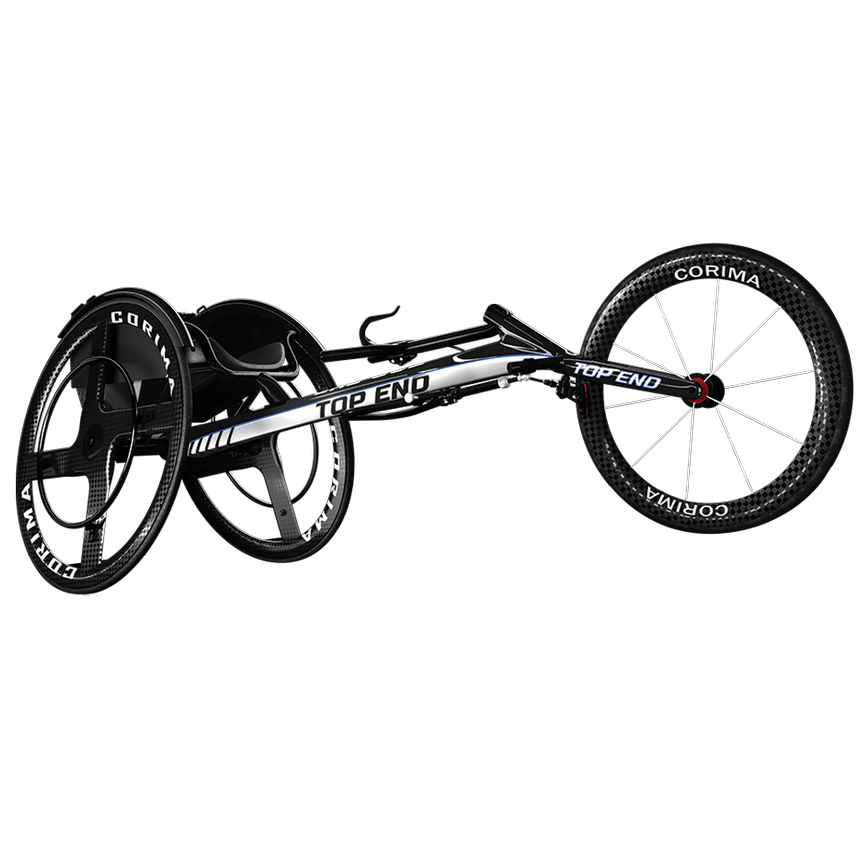
The Eliminator NRG Racing Wheelchair is Top End’s fastest, lightest, stiffest and most responsive ride available designed specifically for adaptive racing athletes seeking to be at the top of the podium.
It features a hybrid design of advanced carbon fiber technology and a custom fit with enhanced aerodynamics, providing a lightweight and stiff frame with a sharp, responsive ride.
A carbon fiber main frame provides increased tensile and yield strength, giving racers a smooth ride and controlled handling while the 200-gram full carbon fork features an aerodynamic design that flows into the headtube, creating clean lines for a sleek appearance.
A tailored and fitted hybrid cage gives athletes the ability to fine tune their positioning, so they can optimize their power transfer to the ground. The new and improved racing compensator improves turning radius and zero-play confidence. The multi-position brake lever can be placed anywhere on the steering handle to accommodate the racer’s preference.
Top End NRG offers an unsurpassed ride quality- introducing Top End's next generation of adaptive sporting equipment.
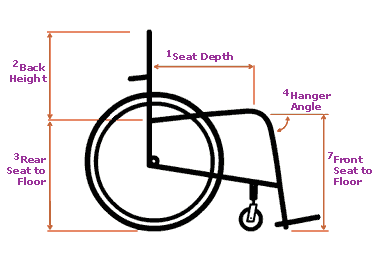
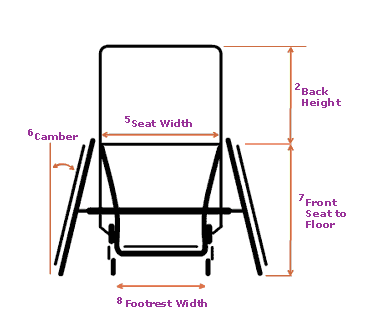
- Seat Depth1
- Measure from the most posterior point of the body to the inside of the knee, minus at least two inches. Optimal contact between the legs and the seat increases stability for the body.
- Back Height2
- Measured from the seat base to the top of the chair back. Sport users need enough height for upper body support, yet low enough to allow the arms and trunk to rotate freely.
- Rear Seat to Floor3
- Measurement from the ground to the rear seat edge. Relative to the front seat-to-floor dimension, this determines the rearward slope ("dump" or "squeeze") of the seat. Sport chairs usually have more dump for extra upper body stability.
- Hanger Angle4
- Determines how far the toes extend away from the body, measured from the horizontal. Sport users often use very tight angles to be able to rotate in the smallest possible space.
- Seat Width5
- Determined by the widest point of the body from knee to hip, plus an inch to ensure room to move. Sport chairs are typically as narrow as possible to save weight which improves agility.
- Wheel Camber6
- Angle of the wheel relative to the vertical. More camber improves stability and agility, but also limits ability to pass through narrow spaces. A typical sport chair uses nine to twelve degrees of camber.
- Front Seat to Floor7
- Measure the leg from the back of the knee to the sole of the foot. Then subtract the thickness of the cushion when it is compressed. Next, add a minimum of two inches for footrest clearance. Do not add the footrest clearance if the chair will be foot-propelled.
- Footrest Width8
- Measure from the inside of each legrest tubing the distance or desired distance between legrests.
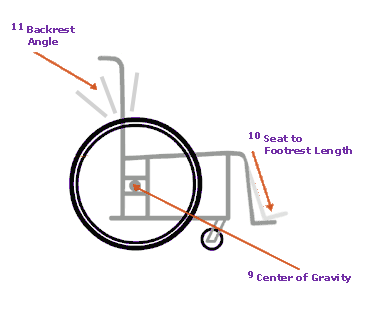
- Center of Gravity9
- Measure from the front of the seat back post to the center of the rear axel.
- Seat to Footrest Length10
- Measure from the edge of the seat upholstery to the top rear of the footrest.
- Backrest Angle11
- Measure the the angle of the back post to the floor. Ninety degrees will be perpendicular to the floor, to approximate the angle from the back post to the seat, subtract two degrees from measurment for every .5" of dump.